

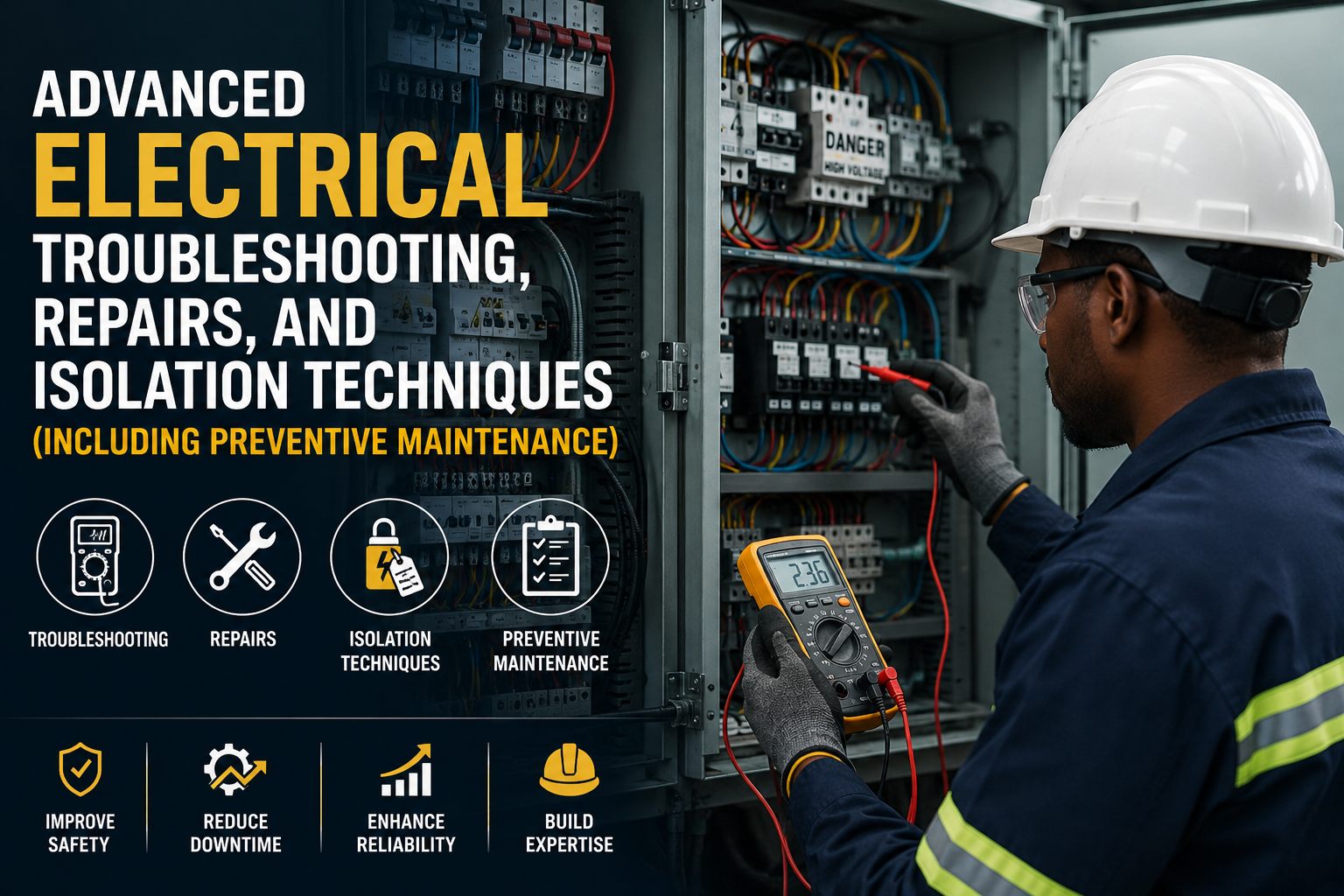
Advanced Electrical Troubleshooting, Repairs, and Isolation Techniques (Including Preventive Maintenance)
Cost per Delegate
R24,999.00
Course Overview
Electrical systems form the backbone of modern industrial, commercial, and utility operations. Failures in these systems can lead to costly downtime, safety hazards, and productivity losses. This intensive training course is designed to provide participants with the advanced knowledge and practical skills required to troubleshoot, repair, and isolate faults in complex electrical systems. It goes beyond basic fault-finding to introduce systematic diagnostic methodologies, the use of advanced test equipment, and the execution of reliable repairs.
Additionally, the course integrates a critical focus on preventive maintenance, empowering professionals to proactively manage the health and longevity of electrical assets. This combination of reactive and proactive maintenance strategies ensures optimized system performance, reduced risk of failure, and enhanced workplace safety.
Participants will gain hands-on experience using industry-grade diagnostic tools and work on real-world scenarios involving motors, switchgear, control circuits, and more. The training is also designed to reinforce compliance with international and local electrical safety regulations, including safe isolation procedures and proper use of personal protective equipment (PPE).
Whether you are working in manufacturing, utilities, mining, or facility management, this course equips you to elevate your troubleshooting accuracy, maintenance effectiveness, and overall system reliability.
Course Objectives
Upon successful completion of this course, participants will be able to:
1. Apply Advanced Troubleshooting Methodologies
Systematically analyze and resolve electrical faults using step-by-step diagnostic processes.
2. Utilize Test Instruments Effectively
Correctly operate diagnostic tools such as multimeters, insulation resistance testers, clamp meters, and thermal imaging cameras.
3. Diagnose and Repair Complex Electrical Systems
Identify, isolate, and repair faults in motors, control panels, distribution boards, drives, and lighting systems.
4. Interpret Electrical Drawings and Schematics
Read and analyze single-line diagrams, wiring schematics, and ladder logic diagrams for accurate troubleshooting.
5. Perform Safe Electrical Isolation
Implement correct lockout/tagout (LOTO) procedures and isolate equipment safely in accordance with best practices and safety standards.
6. Execute Effective Repairs
Apply industry-standard techniques for rewiring, cable termination, component replacement, and electrical restoration.
7. Implement Preventive Maintenance Practices
Design and carry out a preventive maintenance program that reduces unexpected failures and enhances asset reliability.
8. Comply with Electrical Safety Standards
Demonstrate knowledge of relevant safety standards (e.g., NFPA 70E, OSHA, IEC) and apply them in daily maintenance and repair tasks.
9. Minimize Equipment Downtime and Improve Reliability
Increase system uptime through accurate fault detection and preventive actions, improving productivity and safety outcomes.
10. Enhance Technical Confidence and Decision-Making
Strengthen the ability to troubleshoot under pressure, make informed repair decisions, and effectively communicate technical issues.
Who Should Attend:
• Electrical technicians and supervisors
• Industrial electricians
• Maintenance engineers
• Electrical safety officers
• Plant operators and facility managers
• Technical personnel responsible for electrical systems in manufacturing, utilities, and infrastructure sectors
Course Outline:
Module 1: Electrical Safety and Standards
• Electrical hazards and risk management
• Lockout/Tagout (LOTO) procedures
• Isolation procedures and permits
• Compliance with OSHA, NFPA 70E, IEC, or local regulations
• Safe use of PPE and insulated tools
Module 2: Principles of Advanced Troubleshooting
• Overview of electrical troubleshooting process
• Logical approach to identifying and diagnosing faults
• Symptom recognition and root cause analysis
• Common faults in industrial systems (short circuits, overloads, open circuits)
Module 3: Diagnostic Tools and Test Equipment
• Digital Multimeters and clamp meters
• Megohmmeters (Insulation Resistance Testers)
• Phase sequence indicators
• Thermal imaging for hot spots
• Oscilloscopes and power analyzers
Module 4: Troubleshooting Common Electrical Systems
• Motors (AC/DC) and motor control circuits
• Variable Frequency Drives (VFDs)
• Lighting systems
• Power distribution panels and circuit breakers
• PLC and control system faults
Module 5: Repair Techniques and Best Practices
• Rewiring and replacement of components
• Repair of faulty terminals, fuses, relays, and contactors
• Cable fault detection and termination
• Soldering and connector replacement techniques
Module 6: Electrical Isolation and Switching Procedures
• Steps for safe isolation of electrical circuits
• Working with high-voltage and low-voltage systems
• Verification of isolation
• Emergency isolation procedures
Module 7: Preventive Maintenance in Electrical Systems
• Definition and importance of preventive maintenance
• Scheduling and planning maintenance tasks
• Inspection checklists and reporting
• Condition-based monitoring
• Predictive maintenance overview (vibration, thermal, ultrasonic, etc.)
Module 8: Interpretation of Electrical Schematics and Drawings
• Single-line diagrams
• Control and wiring diagrams
• Ladder logic reading for troubleshooting
• Updating and marking modified drawings
Module 9: Practical Troubleshooting Workshops
• Simulated faults in industrial panels and motors
• Hands-on troubleshooting using tools and instruments
• Isolation drills and response to emergency scenarios
• Group troubleshooting exercises and reporting
________________________________________
Training Methodology
• Instructor-led sessions with real-world case studies
• Hands-on workshops and lab-based learning
• Group problem-solving exercises
• Interactive Q&A and feedback sessions
End of the Workshop
For Training arrangements call us on the detail below
TANZANIA: +255 749 50 26 78
SOUTH AFRICA: +27 694 31 79 73
KENYA: +255 749 50 26 78
DUBAI: +27 694 31 79 73
