

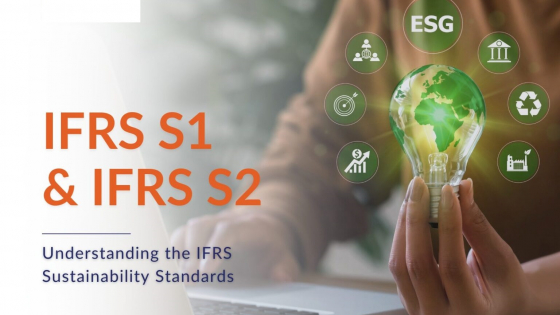
IFRS Sustainability Reporting
Application Guidance 2026
Mastering Climate and ESG Disclosures
14 - 18 September 2026
Sandton
Johannesburg South Africa
Cost per Delegate
R19,999.00
Introduction
As environmental, social, and governance (ESG) issues increasingly influence business performance and investment decisions, organizations are expected to provide transparent, reliable, and decision-useful sustainability disclosures. The IFRS Sustainability Disclosure Standards (IFRS S1 and IFRS S2) issued by the International Sustainability Standards Board (ISSB) provide a globally recognized framework for reporting sustainability-related risks and opportunities that affect enterprise value.
This comprehensive five-day programme is designed to equip professionals with the practical knowledge and skills required to implement the 2026 IFRS Sustainability Reporting Application Guidance. Participants will gain an in-depth understanding of climate-related financial disclosures, ESG reporting principles, governance requirements, materiality assessments, greenhouse gas (GHG) emissions reporting, scenario analysis, sustainability metrics, and assurance readiness. Through practical workshops, case studies, and hands-on reporting exercises, participants will learn how to prepare high-quality sustainability disclosures that meet investor, regulatory, and stakeholder expectations.
Objectives:
Upon completion of this programme, participants will be able to:
• Understand the principles and requirements of IFRS Sustainability Disclosure Standards (IFRS S1 and IFRS S2).
• Apply the 2026 IFRS Sustainability Reporting Application Guidance.
• Identify and assess sustainability-related risks and opportunities affecting enterprise value.
• Conduct financial materiality assessments for sustainability reporting.
• Develop effective ESG governance and oversight frameworks.
• Prepare climate-related disclosures in accordance with IFRS S2.
• Measure and report greenhouse gas (GHG) emissions, including Scope 1, Scope 2, and Scope 3 emissions.
• Perform climate scenario analysis and assess climate resilience.
• Develop meaningful ESG metrics, targets, and key performance indicators (KPIs).
• Integrate sustainability reporting with financial reporting and enterprise risk management.
• Strengthen internal controls, data governance, and assurance readiness for sustainability reporting.
• Prepare comprehensive, investor-focused ESG reports aligned with international best practices.
Who Should Attend?
• Chief Financial Officers (CFOs)
• Finance Directors
• Sustainability Directors and Managers
• ESG Managers and Specialists
• Finance Managers
• Financial Controllers
• Chief Risk Officers (CROs)
• Enterprise Risk Managers
• Internal Auditors
• External Auditors
• Compliance Officers
• Corporate Governance Professionals
• Company Secretaries
• Environmental Managers
• Climate Change Specialists
• Investor Relations Managers
• Strategy and Business Planning Managers
• Regulatory Reporting Officers
• Board Members and Board Committees
• Management Accountants
• Consultants advising on ESG and sustainability reporting
Course Outline
Module 1: Global Sustainability Reporting Landscape
• Evolution of ESG reporting
• Introduction to the ISSB and IFRS Sustainability Standards
• IFRS S1 and IFRS S2 overview
• Global sustainability reporting trends
• Regulatory developments and adoption
• Sustainability reporting and enterprise value
• Relationship between financial and sustainability reporting
Module 2: IFRS Sustainability Reporting Application Guidance 2026
• Structure of IFRS Sustainability Standards
• Key reporting principles
• Reporting boundaries
• Connected information
• Reporting periods
• Material information
• Fair presentation
• Judgements and estimation uncertainty
• Recent application guidance and implementation updates
Module 3: ESG Governance and Leadership
• Board oversight of sustainability
• Governance responsibilities
• ESG governance frameworks
• Executive accountability
• Sustainability committees
• Governance policies
• Ethical leadership
• Stakeholder engagement
Module 4: Sustainability Strategy and Enterprise Value
• Business strategy and sustainability
• Identifying sustainability risks and opportunities
• Value creation
• Strategic planning
• Capital allocation
• Long-term sustainability objectives
• Integration with corporate strategy
Module 5: Materiality Assessment
• Financial materiality under IFRS
• Identifying material ESG issues
• Risk prioritization
• Materiality assessment process
• Stakeholder input
• Documentation and evidence
• Materiality workshops
Module 6: Climate Risk and Opportunity Disclosures
• Climate-related financial risks
• Physical climate risks
• Transition risks
• Climate opportunities
• Climate resilience
• Climate adaptation
• Sector-specific climate considerations
Module 7: Greenhouse Gas (GHG) Emissions Reporting
• GHG Protocol overview
• Scope 1 emissions
• Scope 2 emissions
• Scope 3 emissions
• Emissions calculation methodologies
• Data collection techniques
• Emissions reporting challenges
• Verification of emissions data
Module 8: Climate Scenario Analysis
• Purpose of scenario analysis
• Climate modelling
• Transition scenarios
• Physical risk scenarios
• Financial implications
• Resilience assessment
• Scenario documentation
• Practical exercises
Module 9: ESG Metrics, Targets and Performance Measurement
• ESG Key Performance Indicators (KPIs)
• Climate-related metrics
• Sustainability performance indicators
• Target setting
• Benchmarking
• Monitoring performance
• Continuous improvement
Module 10: Sustainability Data Management
• ESG data governance
• Internal reporting systems
• Data quality management
• Evidence collection
• Internal controls
• Data validation
• Technology solutions
• Reporting systems integration
Module 11: Preparing IFRS Sustainability Reports
• Report structure
• Mandatory disclosures
• Climate disclosures
• ESG disclosures
• Cross-referencing financial statements
• Integrated reporting
• Disclosure examples
• Common reporting challenges
Module 12: Assurance and Compliance
• Sustainability assurance
• Internal audit readiness
• External assurance requirements
• Documentation standards
• Internal controls
• Regulatory compliance
• Continuous monitoring
• Best practices
Module 13: Practical ESG and Climate Reporting Workshop
• IFRS S1 reporting exercise
• IFRS S2 climate disclosure exercise
• ESG reporting case study
• Climate scenario simulation
• Materiality assessment workshop
• GHG emissions calculation exercise
• Sustainability report preparation
• Peer review and feedback
End of the Workshop
For Training arrangements call us on the detail below
TANZANIA: +255 749 50 26 78
SOUTH AFRICA: +27 694 31 79 73
KENYA: +255 749 50 26 78
DUBAI: +27 694 31 79 73
